Oct 28, 2026Private Label Guides
Why Cleansing Balm Texture Can Change With Temperature
A cleansing balm sample may feel perfect at room temperature but behave differently during summer shipping or winter storage. Here is what beauty brands should evaluate before bulk production.
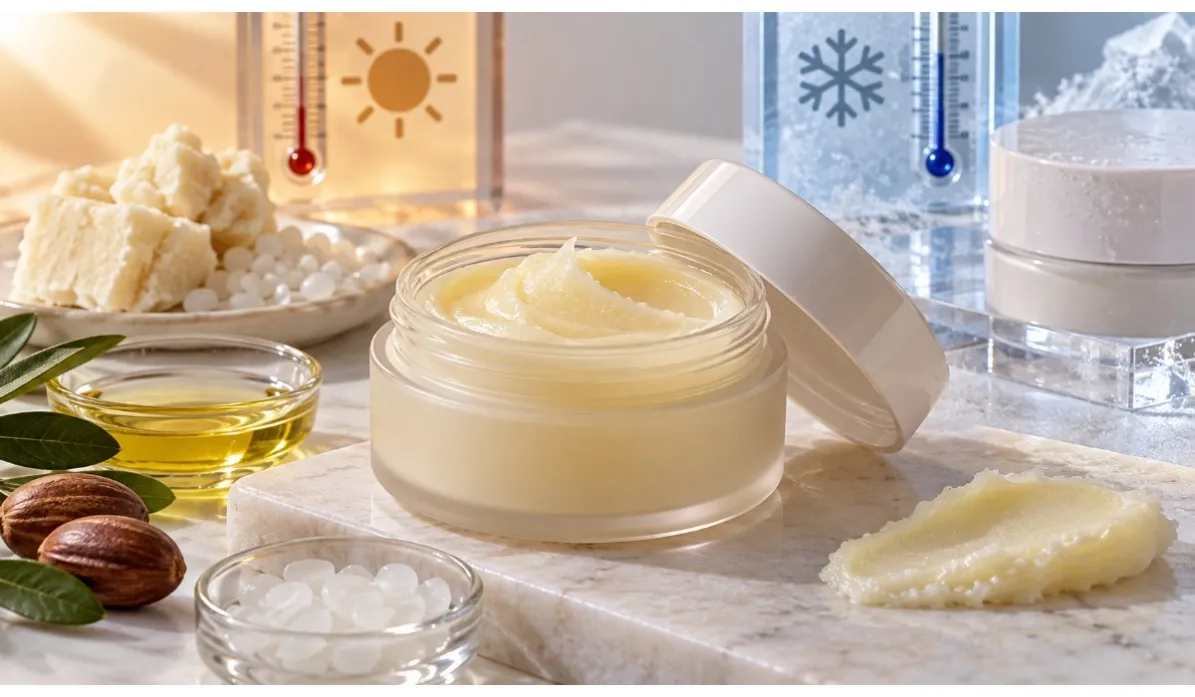
A cleansing balm sample arrives with the expected appearance and texture. It is smooth, easy to scoop and melts comfortably during application.
The buyer approves it—but then asks an important question:
Will the product remain the same during summer transportation, warehouse storage and seasonal temperature changes?
This question should be addressed before bulk production, especially for waterless formulas containing different combinations of oils, butters, waxes and oil-soluble ingredients.
An anhydrous formula does not contain a conventional water phase, but that does not mean its texture is unaffected by temperature.
Waterless Does Not Mean Temperature-Proof
The structure of a cleansing balm depends on the balance between liquid oils and ingredients that give the product firmness.
When the surrounding temperature changes, that balance may become more visible.
Depending on the formula, a balm may:
- become softer at higher temperatures;
- feel firmer in a cold environment;
- show a small amount of surface oil;
- develop an uneven or grainy texture;
- melt and resolidify differently after temperature cycling;
- dispense differently from the selected packaging.
These observations do not automatically mean the formula has failed. The important question is whether the changes remain within the agreed product standard and whether the balm returns to an acceptable condition after normal storage.
For a private label waterless cleansing balm, the target texture should therefore be defined before stability evaluation begins.
What Does “Grainy” Cleansing Balm Mean?
A grainy balm may contain small particles or uneven areas that can be felt when the product is scooped or applied.
This can sometimes occur when certain structured ingredients melt and recrystallize at different rates. Repeated heating and cooling may make the effect more noticeable.
The issue should not be evaluated only from a photograph. The development team needs to understand:
- when the graininess appeared;
- how the sample was stored;
- whether it experienced heat during transportation;
- whether the particles melt during application;
- whether the appearance continues to change;
- whether the product still emulsifies and rinses normally.
This information helps distinguish a temporary texture observation from a more significant stability concern.
Why Surface Oil Can Appear
Brands sometimes describe small oil droplets on the surface as “sweating.”
This may happen when the internal structure of the balm does not hold the liquid-oil portion consistently under certain conditions. Temperature exposure, ingredient balance and the cooling process can all influence the result.
The manufacturer should evaluate whether the oil can be reincorporated, whether it reappears and whether the product remains uniform throughout the container.
The objective is not simply to make the surface look acceptable on the day the sample is inspected. The formula should remain suitable for its expected shelf life, storage conditions and distribution route.
Do Not Evaluate Stability in a Laboratory Jar Alone
Early formula samples are often supplied in simple laboratory containers. These are useful for comparing texture, cleansing performance and rinse-off feel.
However, the final stability assessment should also consider the intended retail packaging.
The same balm can behave differently depending on:
- jar diameter and depth;
- container material;
- closure structure;
- liner or sealing system;
- available headspace;
- filling temperature;
- exposure to light;
- leakage resistance during transportation.
A formula that performs well in a small sample jar still needs to be reviewed with the proposed commercial container.
Our guide to approving final skincare packaging explains the wider packaging checks that should be completed before production.
What Should a Cleansing Balm Stability Review Cover?
The exact test plan depends on the formula, packaging and target market. However, a practical review normally considers several areas.
1. Appearance
Check whether the balm remains visually uniform.
Look for unexpected separation, surface oil, graininess, color change or movement inside the container.
2. Texture and Firmness
The product should remain usable across its expected storage conditions.
A balm that becomes excessively hard may be difficult to scoop. A formula that becomes too soft may move inside the jar, leak around the closure or create an inconsistent consumer experience.
3. Melting and Application
The balm should still melt and spread according to the approved product concept.
Temperature exposure should not cause the formula to become unexpectedly waxy, oily or uneven during use.
4. Emulsification and Rinsing
Appearance is only one part of product performance.
After storage testing, the balm should still transform properly when water is added and rinse according to the approved standard.
5. Fragrance and Odor
Check whether the fragrance remains consistent and whether any unusual odor develops during storage.
Fragrance should be evaluated in the actual base formula rather than approved only from a fragrance strip or fragrance oil sample.
6. Packaging Compatibility
Confirm whether the jar, liner, seal and closure remain suitable for the formula.
The review should include leakage, deformation, discoloration, product residue around the closure and any visible interaction between the balm and its packaging.
A Proven Base Formula Still Needs Final Confirmation
Using an existing, market-tested cleansing balm base can reduce unnecessary development work. It gives the project a more reliable starting point than building every element from zero.
However, “proven base formula” does not mean that every customized version will behave identically.
Changes involving fragrance, botanical oils, color, active ingredients or packaging may affect the final product. Even when the main formula structure remains unchanged, the customized version should still be confirmed before production.
This is why brands should clearly separate two decisions:
- Is the existing base formula suitable as the starting point?
- Is the final customized formula suitable in the selected packaging?
Our custom formulation and packaging services cover formula selection, sample adjustment, packaging sourcing and production coordination.
How Should Buyers Report a Temperature-Related Problem?
General comments such as “the texture changed” are difficult for an R&D team to investigate.
More useful feedback would be:
The sample was smooth when received. After three days in a warm room, a small amount of oil appeared on the surface. The balm remained soft after returning to normal room temperature, but it still emulsified and rinsed normally.
When reporting an observation, include:
- sample identification or version;
- approximate storage temperature;
- duration of exposure;
- photographs before and after storage;
- whether the package was opened;
- changes in appearance, odor and texture;
- whether performance changed during use;
- whether the product recovered at room temperature.
This gives the formulator a clearer basis for evaluating the sample and deciding whether an adjustment is necessary.
What Should Be Confirmed Before Bulk Production?
Before approving a private label cleansing balm for production, confirm:
- the final formula version;
- the target texture and firmness;
- the expected melting and rinse-off performance;
- the final fragrance and fragrance level;
- the selected jar and closure;
- the acceptable appearance standard;
- the intended markets and shipping conditions;
- the required stability and compatibility evaluation;
- the approved reference sample;
- the production and launch timeline.
After the formula and packaging have been approved, review what happens after skincare sample approval before issuing the bulk order.
Stability Should Be Discussed Before the Launch Date Is Fixed
Temperature stability is not a final question to ask after packaging has been printed and production materials have been ordered.
It should be considered while the formula, packaging and target market are still being confirmed.
A realistic development process is:
Formula selection → sample evaluation → formula adjustment → packaging confirmation → stability and compatibility review → final approval → bulk production
BEGO Beauty supports private label and OEM/ODM cleansing balm projects using existing formula bases or customized development routes.
To evaluate a cleansing balm project, send us:
- desired texture and skin feel;
- makeup-removal expectations;
- preferred ingredients or exclusions;
- fragrance requirements;
- packaging format and capacity;
- target market;
- estimated order quantity;
- expected launch date.
Contact BEGO Beauty to discuss formula options, samples, packaging and production requirements for your cleansing balm project.