
Sep 7, 2026Private Label Guides
How Should Beauty Brands Set a Target Cost Before Asking for an OEM Skincare Quote?
Before requesting an OEM skincare quote, learn how beauty brands can use retail price, packaging, formula and order quantity to set a realistic target product cost.
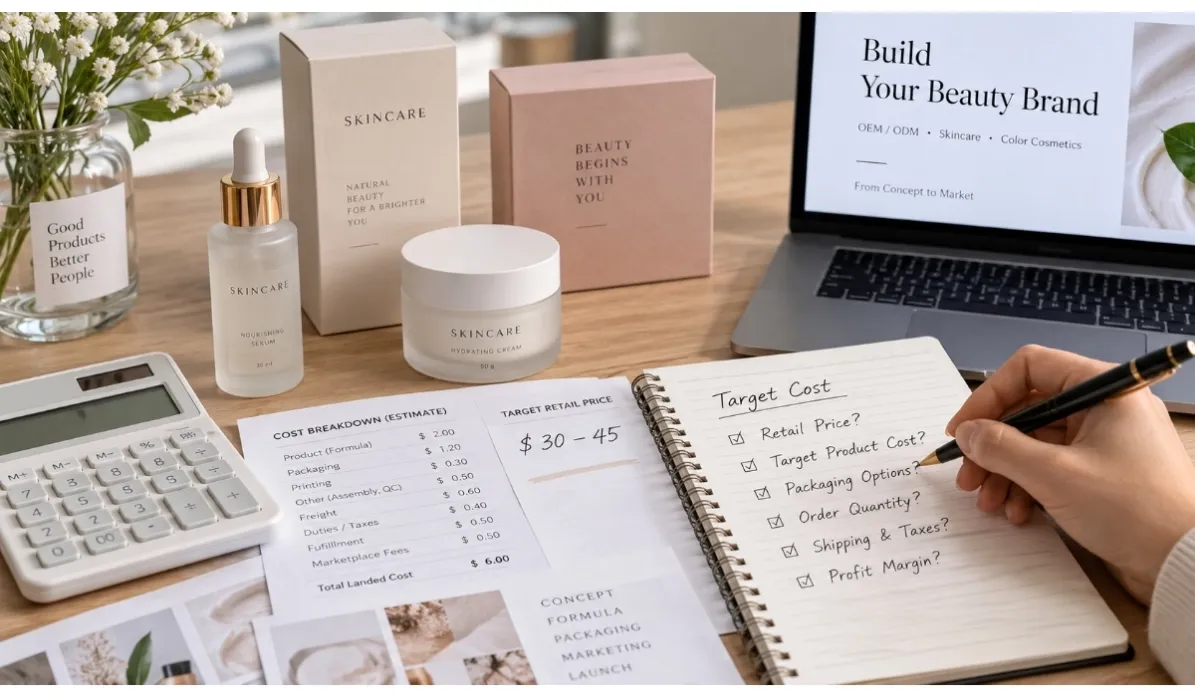
A buyer recently asked us for a quotation on several skincare products.
The first thing we could have done was send a price.
But that would not have been very useful.
Before recommending a formula or packaging option, one question matters:
“What price does the finished product need to work at for your business?”
For beauty brands, product development becomes much easier when the manufacturer understands the commercial target — not only the ingredient wish list.
Start with the expected retail position
A serum planned to retail at $15 and a serum planned to retail at $60 should not automatically be developed in the same way.
The expected retail price influences decisions such as:
- formula complexity
- active ingredient level
- bottle selection
- printing
- secondary packaging
- overall presentation
That does not mean a higher retail price should automatically mean an expensive formula.
It simply gives the product development team a clearer commercial framework.
Separate “product cost” from “landed cost”
This is one area where new buyers can easily underestimate their real cost.
The factory unit price is only part of the final number.
Depending on the project, the buyer may also need to consider:
So if your maximum landed cost is $5, you usually cannot ask the factory to build a $5 product and still expect everything else to fit inside the same budget.
Working backward helps.
Packaging can consume more budget than expected
We often see brands spend a lot of time discussing ingredients, then discover later that their preferred bottle or box changes the economics of the project.
For an early-stage brand, a standard bottle with strong branding may sometimes be a better commercial decision than a fully customized packaging structure.
The money saved there can be used for:
- better formula
- marketing
- launch inventory
- customer acquisition
The “best” packaging is the packaging that supports the business model.
Quantity also changes what is realistic
A target cost without an estimated quantity is difficult to evaluate.
The economics of:
500 units
and:
5,000 units
can be very different.
Packaging, printing and raw-material purchasing may all have quantity-related cost differences.
Target cost + expected first order quantity
A Real Project Conversation
In one skincare project, the buyer originally focused on the formula concept and several preferred ingredients.
Before we moved too far into development, we asked about the planned retail price and expected production quantity.
That changed the discussion.
Instead of simply trying to add every requested feature, the project could be evaluated based on:
what customers would pay, what the brand could invest, and which features actually mattered most.
That is a healthier way to develop a product.
Not every idea needs to be removed.
It just needs to be prioritized.
A Better Way to Ask for a Quote
Instead of:
“Please send me your best price for a serum.”
Try giving your supplier:
“We are planning a 30ml serum for our online brand. Target retail price is around $30, first order is approximately 1,000–2,000 units, and we would like to keep the product cost within a workable range while prioritizing the formula over complex packaging.”
That gives an OEM/ODM manufacturer much more useful information.
For beauty brands, the purpose of a target cost is not to force the lowest possible price.
It is to help the manufacturer build a product that can actually work commercially.
At BegoBeauty, we support private label skincare and color cosmetics projects from formula development to packaging and bulk production.
If you already know your expected retail positioning and first order quantity, those two numbers are often a very good place to start the product discussion.