
Sep 10, 2026Success Stories / Case Studies
A Real Skincare Sourcing Case: What an Oman Buyer Needed Before Moving Forward
A real private label skincare inquiry from Oman shows why buyers should confirm MOQ, product specifications, pricing and CFS requirements before development.
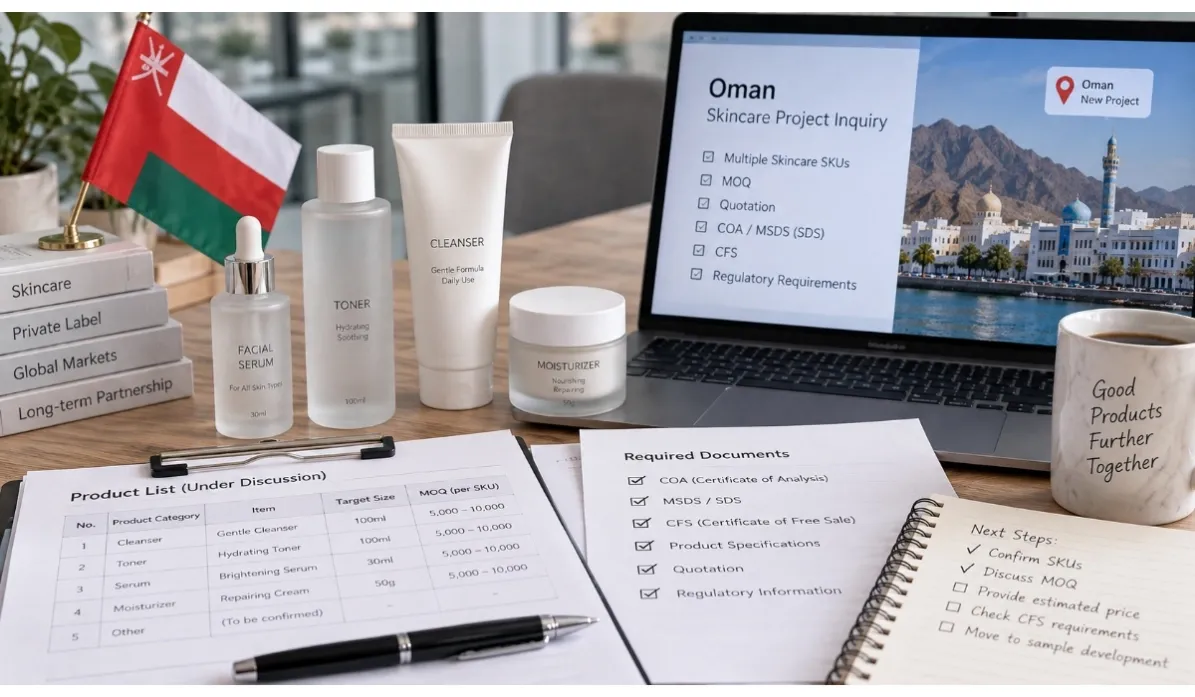
A recent skincare inquiry from Oman reminded me how quickly a project can become complicated when several products, pricing and compliance documents are being discussed at the same time.
The buyer was not asking about one simple serum.
They were evaluating multiple skincare SKUs and wanted to understand three things before moving forward:
MOQ, pricing and available product documents.
That sounds straightforward.
But in practice, each one affected the next decision.
The first question was MOQ
For this project, our normal production MOQ is 10,000 pieces per product.
For an initial cooperation, we discussed the possibility of starting from 5,000 pieces per SKU.
This is an important conversation to have early.
If a buyer is planning five products, for example, “5,000 pieces” does not necessarily mean 5,000 pieces total.
It may mean:
5,000 × each formula / SKU.
For a new product line, that difference has a major impact on inventory and cash flow.
This is why I prefer confirming the planned SKU count before spending too much time on detailed quotation work.
A quotation needs more than a product name
The buyer also wanted estimated pricing.
But a meaningful skincare OEM quotation depends on more than whether the product is called a serum, cream or cleanser.
We need to consider things such as:
- Formula positioning
- Key ingredients
- Packaging
- Filling size
- Quantity
- Target market
If these details are still changing, it is better to call the first number an estimated price, rather than pretending it is already the final production quotation.
That distinction protects both sides from confusion later.
The compliance question was more important than it first appeared
The buyer asked whether we could provide documents including:
COA, MSDS/SDS and CFS.
COA and SDS are common topics in cosmetics sourcing.
The CFS question needed a little more care.
Instead of simply replying:
“Yes, we can provide CFS.”
we asked the buyer to confirm which issuing authority or format their importer or registration process in Oman would accept.
Why?
Because a document can be called a Certificate of Free Sale, but the importing authority may have specific requirements regarding who issues it or how it must be legalized.
Producing the wrong document first creates cost and delay without solving the buyer's registration problem.
That is a good example of why sourcing is not only about answering “yes” or “no.”
Sometimes the better answer is another question.
What this project taught us
At this stage, the buyer does not need more product brochures.
They need clarity.
Before samples or bulk production, both sides need to understand:
How many SKUs are being developed?
What quantity is realistic per SKU?
What is included in the estimated price?
Which documents are actually required by the destination market?
Once those points are clear, the formula and packaging discussion becomes much more efficient.
For beauty brands sourcing private label skincare internationally, I think this is one of the most useful habits:
Confirm the commercial and regulatory framework before trying to finalize the product.
It can prevent a lot of unnecessary development work later.
BegoBeauty supports private label skincare and color cosmetics projects for international brands, importers and distributors.
For projects involving market-specific documentation, we prefer to confirm the buyer's actual registration requirements first rather than assume that one document format works for every country.