
Sep 1, 2026Private Label Guides
What Should Beauty Brands Check During Bulk Skincare Production?
Learn what beauty brands should watch during bulk skincare production, including batch consistency, filling accuracy, packaging quality and final inspection.
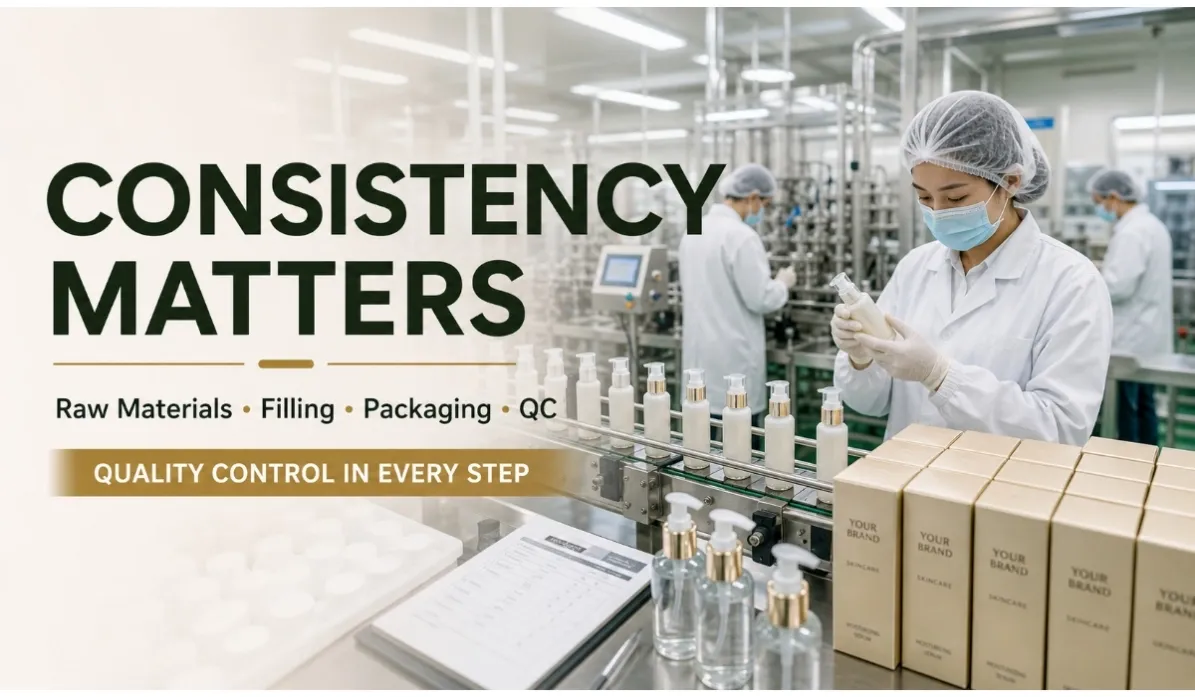
Approving a skincare sample is exciting.
It means the formula, texture and overall product direction are finally where you want them to be.
But one thing I often remind buyers is this:
An approved sample is only one unit. Bulk production is about keeping hundreds or thousands of units consistent with that approval.
That is where quality control becomes important.
A client once visited our facility after we had spent quite a lot of time discussing specifications, pricing and packaging.
What changed the conversation was not seeing a large production line.
It was seeing the small checkpoints in between.
Raw materials were checked before production. Filling quantities were monitored. Finished packaging was inspected before products moved to the next stage.
The client began asking fewer questions about the production line itself and more questions about one thing:
“How do you make sure the bulk order stays consistent?”
That is a much better question for any beauty brand preparing for mass production.
The bulk formula should be compared with the approved sample
Before filling begins, the bulk batch should be checked against the approved reference.
Depending on the skincare product, this may include:
- appearance
- color
- odor
- viscosity
- texture
- overall feel
This matters because even when the formula itself has not changed, raw-material variation or production conditions can sometimes affect the final appearance or texture.
The earlier a difference is found, the easier it is to investigate before thousands of units are filled.
Filling accuracy matters more than it looks
A bottle that is slightly underfilled or overfilled may not seem like a major issue when you look at one sample.
Across a larger production run, it becomes more important.
Consistent filling affects:
product presentation, material usage, cost control and customer experience.
For buyers, it is useful to understand how the manufacturer checks filling volume and whether containers are inspected during production.
Packaging should still be checked during production
Packaging was approved before production, but that does not mean it should be ignored once mass production begins.
Printed components can still have variation.
Labels can be misaligned.
Pumps and caps can be assembled incorrectly.
Boxes can be damaged during packing.
A skincare product with an excellent formula can still disappoint customers if the finished packaging looks inconsistent.
This is why the final product should be reviewed as a complete unit — not as formula and packaging separately.
Ask what the factory checks before shipment
You do not need to stand beside the production line yourself.
But as a buyer, you should know what happens before the order is released.
Depending on the project, final checks may cover:
- product appearance
- packaging condition
- printing
- leakage
- quantity
- carton packing
- shipping marks
For overseas beauty brands, production photos, packing photos or a pre-shipment inspection can also provide another level of confirmation before the goods leave the factory.
Bulk production is really about reducing variation
Many buyers focus heavily on getting the sample right.
That is important.
But once the sample is approved, the challenge changes.
The question becomes:
Can the manufacturer reproduce that approved standard consistently across the entire order?
For a growing skincare brand, consistency protects more than one shipment.
It protects customer experience, repeat purchase and brand reputation.
At BegoBeauty, we support beauty brands with private label and OEM/ODM skincare development from formula sampling through packaging and bulk production.
If your sample has already been approved, the next useful conversation is not simply:
“When can production start?”
It is:
“What will be checked during production, and how will the final order be confirmed before shipment?”