
Sep 16, 2026Private Label Guides
What Should Buyers Confirm Before Approving Private Label Lip Liner Samples?
Before approving private label lip liner samples, check shade accuracy, texture, wooden pencil finish, logo and packaging to avoid changes during bulk production.
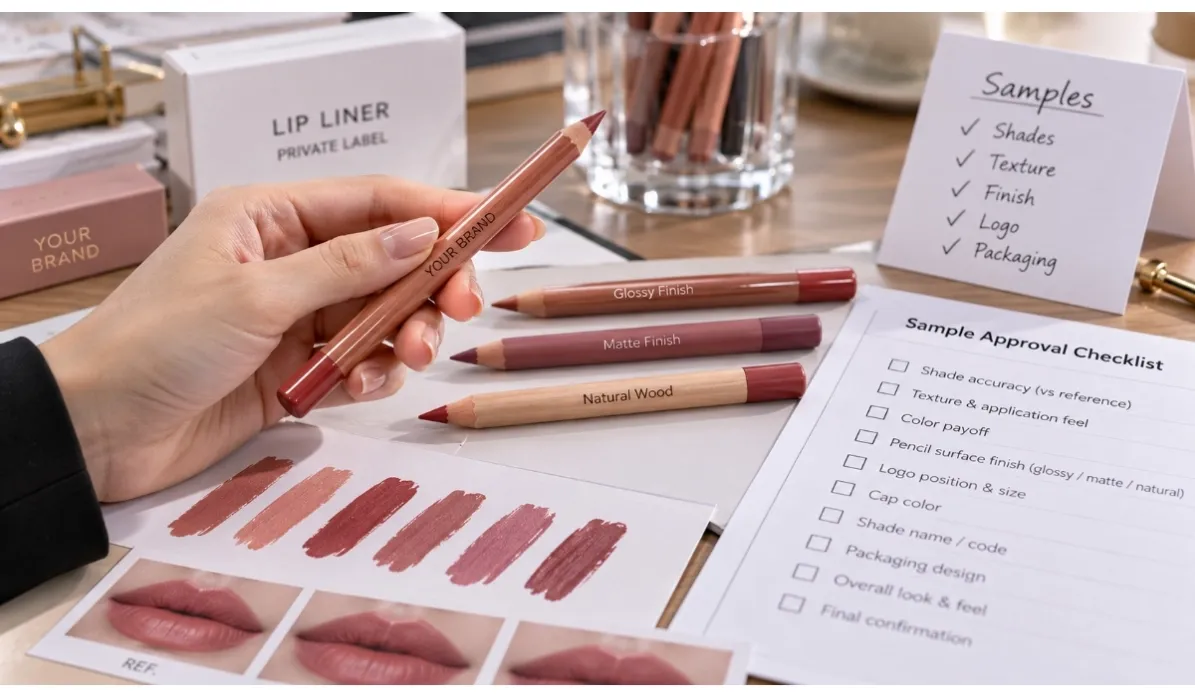
Receiving the right shade is only one part of approving a private label lip liner.
A current wooden lip liner project reminded me of this.
The buyer recently sent us physical reference pencils from the United States. After checking the samples, there were 12 unique shade references.
That gives us a much clearer color target.
But before another sampling round moves forward, there is another question we still need to confirm:
Should the wooden pencil keep the same glossy surface finish as our previous sample, or should we change it?
That small question shows why lip liner approval should never be based on shade alone.
A shade can match — and the sample can still feel wrong
When a brand receives a lip liner sample, the first reaction is usually:
“Is the color correct?”
Of course that matters.
But once the shade is close, I would also test how the pencil behaves during actual application.
Does it glide smoothly?
Is the payoff strong enough in one stroke?
Does it feel too dry?
Is it too creamy for the positioning of the product?
Does the line stay precise?
Two lip liners can have very similar colors but create very different user experiences.
That is why shade matching and texture evaluation should happen together.
The physical pencil is part of the product
For wooden lip liners, the outside finish also matters.
Our previous sample used a gloss coating on the pencil surface.
There is nothing automatically right or wrong about that finish.
The question is whether it matches the brand.
A glossy barrel may feel more polished for one collection.
Another brand may prefer a softer matte or more natural wooden appearance.
This is the kind of detail that is much easier to change during sampling than after thousands of pencils have already been produced.
Check the shade on skin, not only inside the pencil
Another useful habit is to compare swatches.
A color may look correct when you compare two pencil tips side by side, but the difference becomes more obvious once both are applied.
For example, one “brown” may pull slightly red.
Another may look more mauve.
A nude shade may appear warm on one skin tone and much cooler on another.
For this reason, our physical references are useful not only because we can see the pencil — we can actually compare how the shade performs.
For brands developing several colors, I also recommend assigning a clear name or reference number to every approved shade.
With 12 colors under development, relying on phrases such as:
“the darker brown”
or
“the second nude”
can quickly create confusion.
Branding should be checked before production, not after
Color cosmetics projects also involve very small printing areas.
On a wooden lip liner, buyers should look carefully at:
- logo size
- logo position
- shade name
- color code
- barrel color
- cap color
- printing clarity
A logo that looks fine on a computer artwork may feel too small once printed on an actual pencil.
This is exactly what samples are for.
Not only:
“Can the factory make it?”
but:
“Does this physical product look and feel the way our brand expects?”
Sample approval should remove questions
For the lip liner project we are currently working on, the physical reference shades have made the color direction much clearer.
The next step is not simply to reproduce twelve pencils.
Before moving ahead, we still want the buyer to confirm details such as the surface finish and how the new samples should compare with the physical references they provided.
That is a much safer approach than assuming those details.
For beauty brands, I think a good sample approval should leave as few unanswered questions as possible.
Once bulk production begins, changing:
shade → texture → barrel finish → printing
becomes much more expensive than changing them during sampling.
At BegoBeauty, we support private label lip liner and color cosmetics projects from physical shade matching and sampling through branding, packaging and bulk production.
If you are reviewing lip liner samples, don't approve only the color.
Approve the product your customer will actually hold and use.