
Sep 2, 2026Private Label Guides
The Sample Was Approved — Why Can Bulk Skincare Still Look Slightly Different?
Approved your skincare sample? Learn why bulk production may show slight differences in color, viscosity or appearance and what beauty brands should confirm before production.
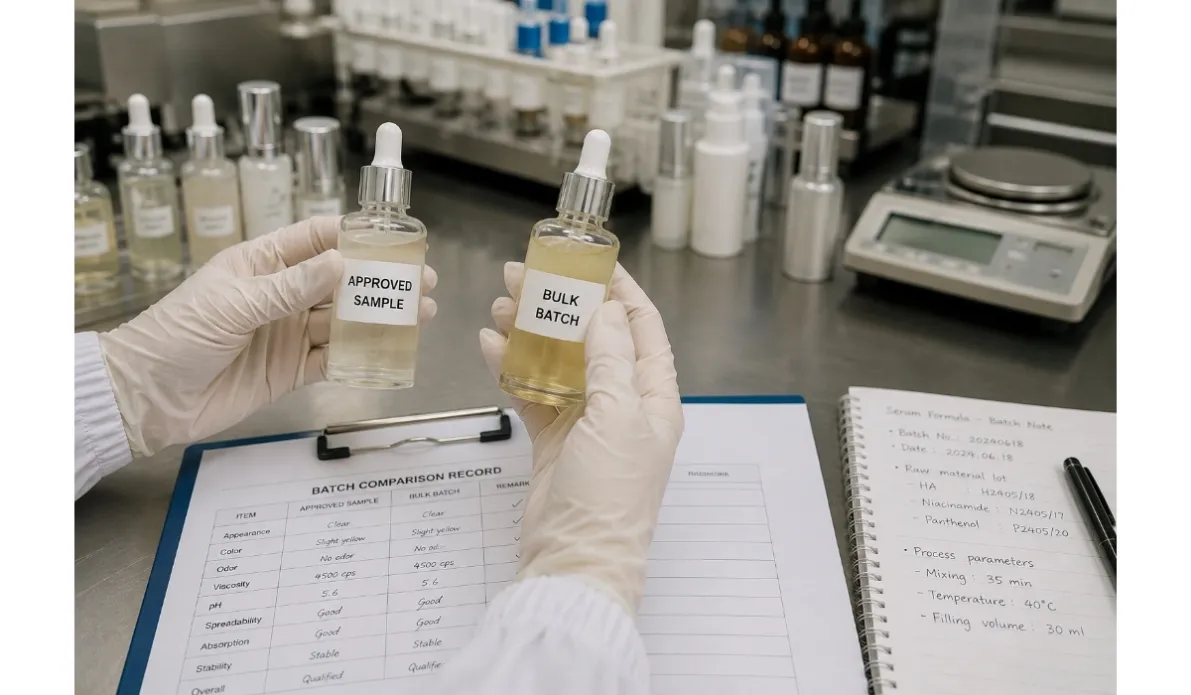
You approve the serum sample.
The texture feels right. The color looks right. Everyone signs off.
Then bulk production begins — and one of the first questions may be:
“Will the production batch look exactly the same as this sample?”
For beauty brands, this is an important question to discuss before manufacturing starts.
The approved sample should be the reference for production, but skincare is not the same as producing a plastic component from a mold. Formulas contain raw materials, and some characteristics can naturally show small variation from batch to batch.
The important issue is not whether every batch is visually identical under every condition.
It is whether the finished product stays within the agreed quality standard.
Start by defining what “matching the sample” actually means
A buyer may look at a sample and simply say:
“This is approved.”
From a production point of view, it is more useful to understand which characteristics matter most.
For a serum, that might be:
Texture, viscosity, color, odor, absorption and overall appearance.
For a cream, consistency and spreadability may matter more.
If one characteristic is especially important to your brand — for example, a very specific pale color or lightweight skin feel — tell the manufacturer before bulk production.
Raw materials can influence appearance
This is something buyers do not always see from the finished sample.
Some cosmetic raw materials can have slight natural variation in color or appearance between lots.
Manufacturing conditions can also influence how a formula looks or feels.
That does not mean a manufacturer should accept uncontrolled variation.
It means the factory needs to compare the bulk batch against the approved standard before thousands of units are filled.
This is one reason raw-material checks and bulk formula inspection matter.
Packaging can change how the product is perceived
Sometimes the formula has not changed at all.
The perception has.
A serum viewed in a clear laboratory sample bottle can look different once it is filled into a frosted, amber or colored retail bottle.
Lighting can also make color differences appear stronger than they really are.
This is why I prefer evaluating the final product as:
Formula + Final Packaging
rather than judging them completely separately.
Don't wait until the goods arrive to discuss acceptance
The best time to discuss consistency is not after the cartons reach your warehouse.
It is before production.
For a custom skincare project, buyer and manufacturer should have a clear reference for the final approved version and understand which characteristics will be checked during bulk production.
If something falls outside the expected range, it is much easier to investigate before filling and packing are completed.
That is also why an approved sample should be kept as a production reference, not treated as something that becomes irrelevant after the PO is placed.
Consistency Doesn't Mean Guesswork
A good bulk-production discussion should answer one simple question:
“How will we know that the production batch still represents the product I approved?”
That conversation is more useful than simply asking whether every unit will be “100% identical.”
For beauty brands, the goal is controlled, repeatable production that protects the customer experience from one order to the next.
BegoBeauty supports private label and OEM/ODM skincare projects from formula sampling through bulk production and packaging.
If you have already approved a formula, the next useful step is to confirm which product characteristics should become the reference standard for production and QC.