
Aug 26, 2026Private Label Guides
Why Do Skincare Samples Keep Getting Revised?
Why do private label skincare samples go through multiple revisions? Learn how clear briefs, specific feedback and packaging confirmation can reduce sample rounds.
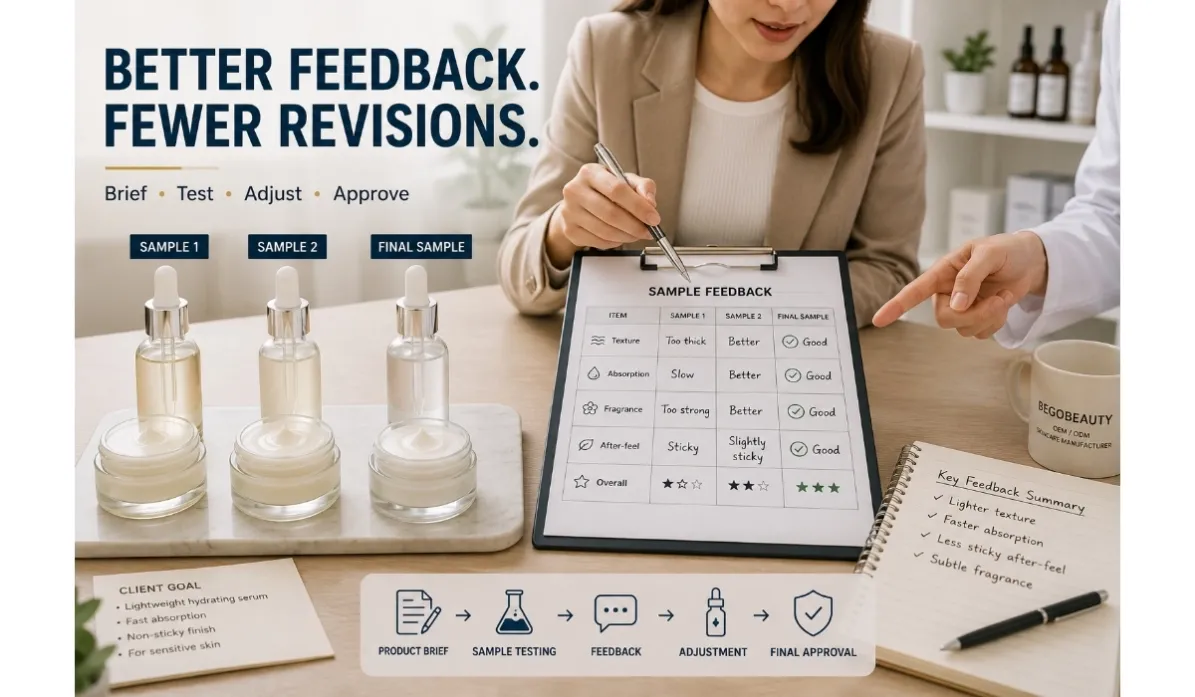
When developing a private label skincare product, buyers sometimes become frustrated after the second or third sample.
A common question is:
“Why can’t the factory get it right the first time?”
In reality, repeated sampling is often not caused by poor manufacturing alone.
Many delays come from unclear product briefs, vague feedback or changing expectations during development.
A Real Example: “The Texture Is Not Right”
One buyer once gave feedback after testing a serum sample:
“The texture is not right.”
That sentence sounds clear, but from a formulation perspective, it leaves many questions.
Does “not right” mean:
- Too thick?
- Too watery?
- Too sticky?
- Too oily?
- Too slow to absorb?
- Too much residue after drying?
After further discussion, the buyer clarified:
“We want a lighter texture, faster absorption and less sticky after-feel.”
That second version of the feedback gave the formulation team a much clearer direction.
The next sample was much closer to what the buyer expected.
1. Start With a Clear Product Brief
Before sampling begins, brands should define as much as possible:
- Target customer
- Product benefits
- Preferred ingredients
- Texture preference
- Fragrance preference
- Reference products
- Target price range
- Packaging type
You do not need to know every technical detail.
But the clearer the product concept is, the easier it is for the manufacturer to translate it into a formula.
2. Avoid Feedback Like “Better” or “Not Good”
Sample feedback should describe the change you want.
Instead of:
“Please make it better.”
Try:
“We want faster absorption, less tackiness and a lighter finish.”
Instead of:
“The fragrance is too strong.”
Try:
“Please reduce the fragrance intensity by around half and make it fresher rather than sweet.”
Specific feedback reduces guesswork.
3. Confirm Whether You Are Testing Formula or Packaging
Another common source of confusion is testing too many things at once.
The first sample may be intended only for formula evaluation.
Final bottles, pumps, labels and boxes may be confirmed later.
If the buyer assumes the first laboratory sample already represents the final retail product, unnecessary revisions can begin before the formula itself is approved.
A practical process is:
Formula sample → formula approval → packaging confirmation → final sample → bulk production
4. Avoid Changing the Product Direction Midway
Sometimes a brand starts with one concept and changes direction after seeing competitors or market trends.
For example:
A hydrating serum may suddenly become a brightening serum.
A lightweight texture may later need to become richer.
A simple stock formula may turn into a fully customized formula.
These changes are possible, but they are not simple “revisions.”
They are effectively a new development direction and may require more time and sampling.
5. Use One Consolidated Feedback List
If several people on the buyer's team are testing the sample, collect all comments before replying to the manufacturer.
Sending separate feedback such as:
Monday: “Make it lighter.”
Tuesday: “Add more fragrance.”
Wednesday: “Actually, less fragrance.”
can make development slower.
A single consolidated feedback document is much easier for the R&D team to follow.
Better Feedback Means Fewer Sample Rounds
The goal of sampling is not to get everything perfect in one attempt.
The goal is to reduce uncertainty before bulk production.
A more efficient process looks like:
Clear brief → sample → specific feedback → adjustment → final approval → production
BegoBeauty supports beauty brands, distributors and skincare retailers with private label and OEM/ODM skincare development, including formula sampling, packaging and bulk production.
To make sample development more efficient, send us:
- Product type
- Target market
- Desired benefits
- Preferred ingredients
- Texture and fragrance expectations
- Reference products, if available
- Estimated bulk quantity
- Packaging requirements
Are you currently revising a skincare sample, or are you preparing your first product brief? Contact BegoBeauty and we can help you make the next sample round more focused.